- For dental professionals
Planning an oral-health learning session
Prepare a session for children, parents or students with a clear objective, a suitable demonstration and a way to check understanding.
Created Updated

Choose one skill to practise
“Learn everything about teeth” does not help us choose an activity. A child ordering a familiar routine, a parent preparing a question for a visit or a student explaining a dental term are more specific objectives. Decide how participants will show what they have learned.
We offer a sample educational plan. It is not a programme we have delivered, an accredited course or a clinical protocol. The educator chooses the format; an appropriately qualified dental professional checks clinical messages and demonstrations. NICE's approach to school oral health connects education with the setting and families. It is UK guidance, not a legal requirement for Bulgaria.
Prepare the setting and materials
Establish age, language, group size and support needs. Make sure people can see, hear and participate, including by pointing or working in pairs. Do not ask for public disclosure of conditions, appointments or family spending.
The example below needs pictures or sequence cards, a teaching model and a parent note. Read the children's daily-care guide and agree the content with the responsible dental professional. For third-party images or worksheets, check reuse permission and identify the publisher.
Tell parents what will be discussed and who can answer individual questions. Clarify required permissions and arrangements with the institution beforehand.
A suggested 20-minute session
This outline is for a group aged 6–11. Adjust timing and tasks to the group; the duration is our suggestion, not a clinical guideline requirement.
- First 3 minutes: show everyday activity cards and invite children to identify when tooth care happens. Avoid comparing who does “best” at home.
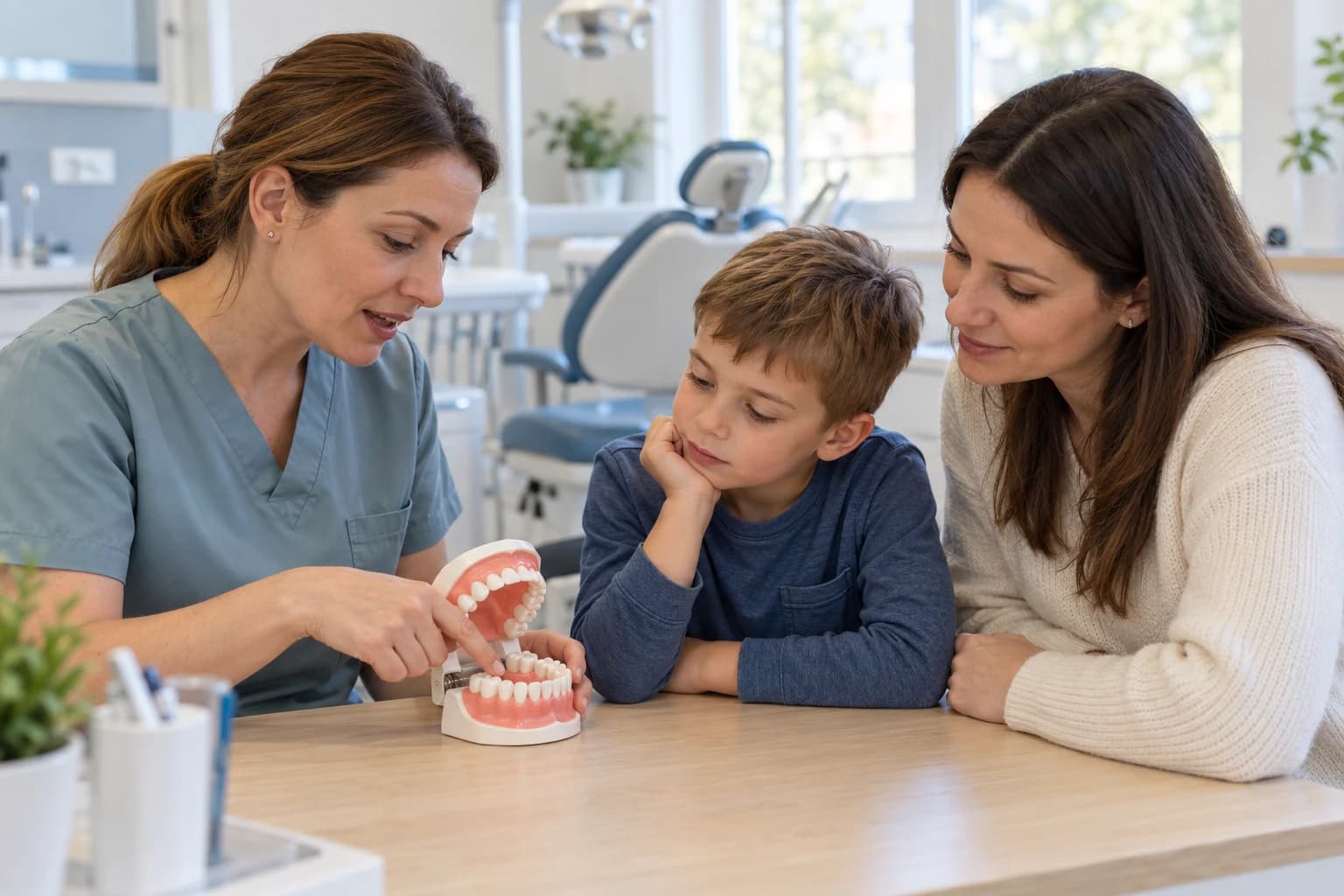
- Next 5 minutes: a professional explains and demonstrates the selected step on a teaching model, using short sentences and allowing questions.
- Next 7 minutes: children arrange the cards in pairs and explain the sequence. The facilitator identifies uncertainty and demonstrates again.
- Last 5 minutes: each child can point to or describe one step. Parents receive the resource link and a topic to discuss at home, without children being judged on family habits.
This activity uses a model and pictures. It does not include brushing in the mouth, examinations or product application.
Adapt the task to the audience
For ages 3–5, use fewer cards and demonstration with an adult. For teenagers, choose a short scenario such as preparing questions about braces, without requiring personal disclosure.
With parents, explore a practical barrier in a fictional family example. With students, use roles: professional, patient and observer. The observer notes unfamiliar terms, room for questions and whether the patient can describe the next step. This practises communication; it does not certify clinical competence.
Practical hygiene needs separate arrangements
Group toothbrushing requires an appropriate protocol and professional responsibility. Before starting, the institution needs to address staff training, consent, individual equipment, storage, infection prevention and responses to problems. A model demonstration does not authorise clinical or hygiene activity.
Do not diagnose children in front of a group or turn a lesson into product advertising. Individual concerns should follow the agreed pathway to parents and dental teams. The national programme has its own responsible institutions.
Sources: Oral health in communities and schools · Bulgaria’s work plan 2026–2030
Sources
- Oral health in communities and schools National Institute for Health and Care Excellence (NICE) · EN
- Bulgaria’s work plan 2026–2030 Министерство на здравеопазването · BG