- For dental professionals
Talking about prevention with patients and parents
A practical conversation plan: understand the difficulty, explain the next step and check that the patient can describe it in their own words.
Created Updated

Start with the difficulty the person describes
“Clean more thoroughly” does not tell someone what to change. Before demonstrating, ask about an ordinary day: when they clean their teeth, who helps and which part is difficult. Pain, tiredness, cost and limited hand movement need different responses. “What gets in the way in the evening?” leaves room for an explanation.
This guide is for dental teams, students and professionals explaining prevention. We help you prepare a conversation and check whether the next step is clear. Assessment, choice of equipment and instructions for an individual remain the treating team's responsibility.
Delivering better oral health considers skills, circumstances and motivation together when discussing behaviour change. We use that framework to guide questions. Giving advice alone does not demonstrate a change in behaviour.
Sources: Supporting behaviour change
Build the conversation around one action
- Agree the priority. “What would you like to find easier after today's visit?” Consider the answer alongside clinical findings and necessary treatment.
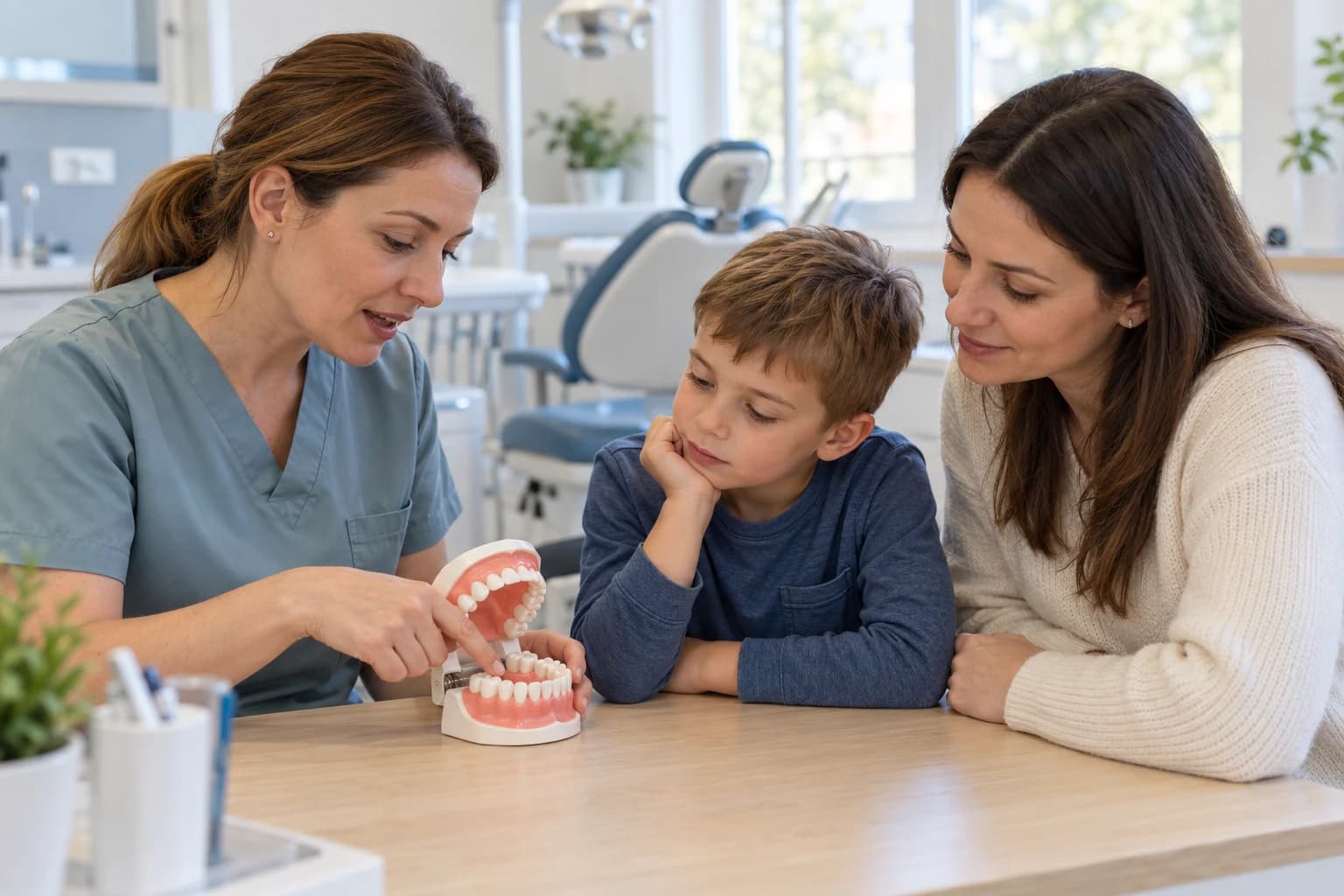
- Ask to explain. “May I show you what I mean?” Use a model, drawing or suitable resource without introducing too many terms.
- Connect the reason to the action. Explain the aim and what home care would involve. When discussing different tools, include limitations, cost and the dexterity needed.
- Work out the practical details. When, where and with what equipment? Who will help if necessary? Record the agreement using the patient's words.
- Check understanding and follow-up. Leave time for a question. Agree when to discuss progress and how to contact the team if a problem arises.
This is our learning outline, not a validated clinical protocol or a compulsory script. An acute concern needs appropriate assessment first. Education must not delay necessary care.
Sources: Shared decision making
Ask the patient to explain the plan back
In teach-back, a person describes their understanding in their own words. AHRQ presents it as a check on how clearly information has been explained. If something is unclear, explain it differently and check again.
You might say: “To check that I explained it clearly, how will this fit into your care at home?” With a model: “Show me where you would start.” The response identifies what to revisit. It does not prove a lasting habit or replace informed consent to treatment.
Two practice conversations
These situations are fictional learning examples. They do not describe our patients or treatments.
An adult with a busy schedule. A patient says they miss the agreed interdental cleaning when they get home late. The professional asks: “When in your day could you find a few quieter minutes?” They identify a possible time and revisit the technique for the tool already selected. The patient describes the plan. At follow-up, the team checks both clinical findings and practical difficulties, rather than treating a promise as a result.
A parent of a young child. A parent describes evening brushing as a repeated argument. The professional asks when the child is most tired and who usually helps. They discuss an age-appropriate routine and practise with a model. The parent explains their part and what might make it difficult. Toothpaste and technique are discussed separately with the clinician; those decisions are not left to the child.
The second conversation can be supported by our children's brushing guide. For discussion of equipment, see oral-care tools and products. Read the selected page first and consider whether it fits the person and their question.
Make the conversation accessible
Ask which language and format work best. Arrange appropriate interpreting or support when needed within the practice's arrangements. Speak to the patient even when a companion is present. Include someone close to them when they wish and it is appropriate to the situation.
With children, use language they understand and involve a parent appropriately. Avoid shame, threats and comparisons with other children. For adults who need assistance, establish what they can do themselves and where support is needed.
Sources: Shared decision making
Sources
- Supporting behaviour change Office for Health Improvement and Disparities · EN
- Shared decision making National Institute for Health and Care Excellence (NICE) · EN
- Checking understanding with teach-back Agency for Healthcare Research and Quality (AHRQ) · EN