- For dental professionals
Disinfection in the dental practice: from surfaces to sterile instruments
Organize hand hygiene, surface treatment, instrument and handpiece processing, and dental-unit maintenance between patients and at the end of the day.
Created Updated
Between patients, hands, contact surfaces, instruments and dental-unit systems require different procedures. Write them so every team member can perform the steps in the correct order. Separate the area for contaminated instruments from the area for processed devices.
Each procedure should state what is being treated, who is responsible, which product or equipment to use, the required conditions and how to check the result. “Disinfect after each patient” does not give the team enough detail to carry out the procedure consistently.
List everything that needs processing
Follow the work from preparing the chair to storing processed instruments. Include surfaces touched with gloves: light handles, switches, keyboards, drawers and auxiliary devices.
| Group | What to describe |
|---|---|
| Hands | When, which product and which technique |
| Clinical contact surfaces | Barrier protection or cleaning and disinfection |
| Reusable instruments | Every step from use to readiness for the next patient |
| Handpieces and intraoral attachments | Instructions for each model |
| Impressions and prostheses | Processing and transfer to the laboratory |
| Suction, spittoon and waterlines | Separate systems and procedures |
| Floors and general equipment | Routine cleaning and disinfection, and what to do after contamination |
Include what happens when a procedure cannot be completed. If a consumable is missing, who decides whether the affected activity can continue, and is a verified alternative available?
Hand hygiene and glove changes
Perform hand hygiene before and after patient care, before putting gloves on and after removing them. Use soap and water when visibly contaminated with blood or other material. Use hand rub according to its instructions. Surgical procedures require surgical hand preparation.
Do not wash or disinfect single-use medical gloves for reuse. Change gloves between patients. When switching from handling contaminated objects to preparing clean materials, take care not to contaminate packs, drawers or processed devices.
These standard precautions apply to every patient, regardless of known infection status.
Surfaces between patients
Distinguish clinical contact surfaces from floors and the wider environment. A disposable barrier can protect a difficult-to-clean surface where compatible with the equipment. Change barriers between patients; after removing a barrier, check for contamination and clean and disinfect the surface as needed.
Clean and disinfect unprotected clinical contact surfaces after every patient. Check compatibility separately for upholstery, touchscreens and metal worktops.
Organic contamination can interfere with disinfectants. Do not replace cleaning with a quick wipe over a visibly contaminated surface. For combined cleaning/disinfecting products, follow the manufacturer's permitted sequence and conditions.
Allow enough time between patients
If the next patient sits down before the stated contact time ends, a condition for disinfectant action has not been met. Allow more time or assess another suitable product with a verified shorter contact time. An internal protocol cannot shorten the manufacturer's requirement.
Try the procedure at the actual workstation before approving it. Can the team reach every surface and allow the necessary time? This shows whether the team can carry out the procedure in the practice. The product’s antimicrobial effectiveness is established through separate testing.
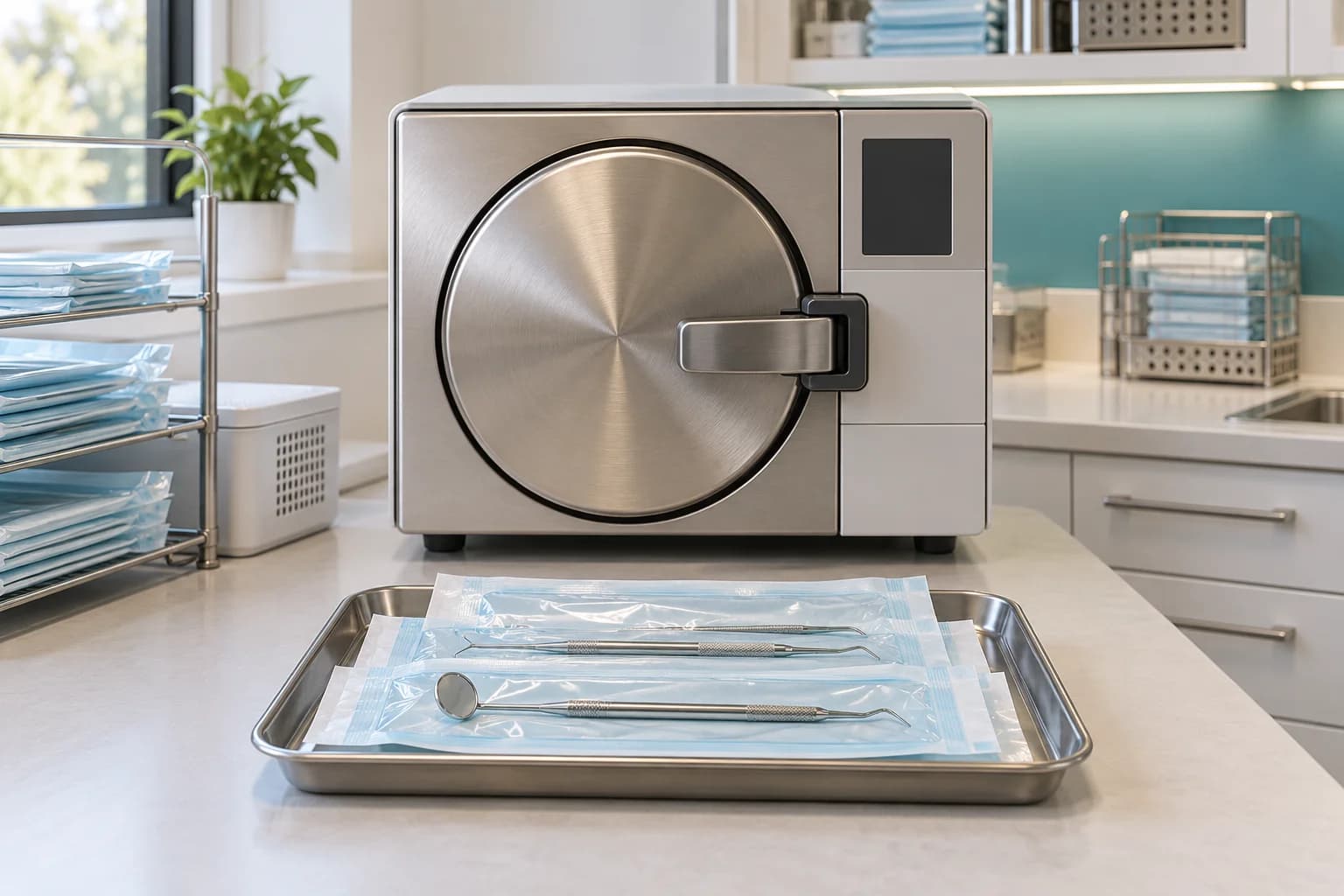
Instrument-processing stages
Describe the entire sequence for reusable devices, matching their risk classification and manufacturer's instructions:
- After use: collect instruments safely and follow the instructions for pretreatment and preventing contamination from drying onto them.
- Transport: a labelled closed container to the processing area.
- Cleaning and disinfection: describe each stage and the permitted manual or automated method.
- Rinsing and drying: as required by the process.
- Inspection and maintenance: check for residues and damage, confirm that the instrument works properly and lubricate it where instructed.
- Packaging and identification: suitable packaging traceable to the processing batch.
- Sterilization: a validated programme suitable for the devices and load.
- Approval for use and storage: check the results and packaging, record the decision on whether the batch can be used, and protect the instruments during storage.
Specify these steps for each device. Inspect before moving on. Residual contamination requires further cleaning; a damaged instrument should be set aside for assessment, repair or withdrawal.
Ultrasonic cleaners and washer-disinfectors
Ultrasound assists cleaning. Merely using an ultrasonic bath does not establish disinfection or provide sterilization. Check the intended use of the equipment and cleaning product, the permitted load, treatment time, maintenance and monitoring requirements.
For washer-disinfectors, programme selection, instrument arrangement and connection of hollow devices to the appropriate adapters matter. Do not add a disinfectant unless it is specified for the machine, or assume that any device that fits inside can be processed in it.
Scotland's SHTM 01-05 (2024) explains these processes and replaces older SDCEP decontamination publications. Its technical guidance is useful, but Scottish organizational rules are not Bulgarian law.
When manual disinfection is permitted
Bulgarian Ordinance Н-4/2026, annex 1, 2.3.1.7.3, permits manual disinfection only in facilities without washer-disinfectors and when the device manufacturer allows it. Manual work needs protection against sharps, splashes and hazardous chemical contact. Do not reach among sharp instruments you cannot see. Use the tools and protective equipment specified by the procedure and risk assessment.
Avoid cleaning movements directed towards your body. For the manual immersion method, annex 1, 2.3.1.6.2 specifies cleaning below the water surface to limit aerosols. Document the conditions for the particular instruments.
Handpieces need internal processing too
Internal handpiece surfaces can become contaminated during use. CDC recommends cleaning and heat sterilization between patients, including the associated reusable attachments described in its guidance.
Keep each model's instructions for disassembly, external and internal processing, lubrication, packaging and cycle selection. Do not assume that a handpiece can be immersed or placed in an ultrasonic bath just because another instrument can. Obtain missing reprocessing instructions from the manufacturer before using it again.
Provide enough handpieces to allow the complete processing cycle before reuse.
Monitoring sterilization
Physical, chemical and biological monitoring supply different information. Printouts record measured parameters; chemical indicators respond to specified conditions; biological indicators use resistant test microorganisms. A colour change on an indicator tape does not, by itself, prove that every device is sterile.
Define who checks results and releases each batch. Set affected instruments aside after a failed or doubtful result. The responsible person investigates and determines corrective action. Depending on the failure, reprocessing or tracing devices already used may be necessary. Repeating a cycle without finding the cause can leave the problem unresolved.
See Bulgarian requirements for monitoring frequencies and records. International recommendations do not replace national requirements or the sterilizer's instructions.
Impressions, prostheses, scanners and sensors
Select a method compatible with the material. Check whether immersion is allowed, treatment duration and subsequent rinsing. The method must not alter the material's dimensions or surface.
For clearer laboratory communication, you can send a short description of what was processed, with which product, under which conditions and when. This gives the laboratory a record of the processing already carried out.
Use the exact model's instructions for intraoral scanner tips and radiographic sensors. After removing barriers, complete the manufacturer's processing steps. Do not immerse or heat a device without checking whether its manufacturer permits this, and use compatible chemicals only.
Suction and waterlines serve different functions
The spittoon and suction system remove contaminated material; waterlines supply treatment water. Do not assume that a product or concentration used in one system is suitable for the other.
For the suction system, check compatibility, dosing, the required quantity and any instructions concerning foaming. State when to clean and disinfect the system, including at the end of the day, following both the equipment instructions and those for the compatible product.
Biofilm can develop in narrow waterlines. A separate reservoir alone does not prevent this. Maintenance requires treatment and monitoring as specified by the manufacturer. For surgical cooling and irrigation, CDC recommends sterile solutions delivered through an appropriate sterile system; an ordinary dental-unit waterline is not such a system.
CDC's US water-quality requirements do not set Bulgarian legal limits. Plan testing around applicable local requirements and equipment instructions.
Spills, sharps injuries and chemical exposure
Biological spills and concentrated chemical spills need separate procedures. For biological material, restrict access, wear the specified protective equipment, remove the material and decontaminate the surface. Never collect sharps with bare hands.
For skin or eye exposure to a chemical, follow the safety data sheet's first-aid instructions and obtain the necessary medical help. Do not improvise neutralization with another chemical. A sharps injury or mucosal contact with potentially infectious material requires you to start the procedure for assessing occupational exposure immediately. Cleaning the workplace does not replace that assessment.
End-of-shift checks
Before leaving, check:
- Are there any instruments or batches whose processing results remain uncertain?
- Is any working solution unlabelled, or is it unclear how long it can still be used?
- Have monitoring results and deviations been recorded?
- Have suction and waterline procedures been completed separately?
- Are processed devices stored correctly?
- Does the next shift know what has been withdrawn and why?
Record unresolved problems, the responsible person and the next action. Only mark a task as complete when it has actually been carried out.
When using foreign guidance, distinguish technical recommendations from rules specific to that country.
Sources
- Bulgarian Ordinance Н-4 of 30 March 2026 Държавен вестник · BG
- Standard precautions in dentistry CDC · EN
- Dental environmental surfaces CDC · EN
- SHTM 01-05, Part C, 2024 NHS Scotland · EN
- Dental handpiece processing CDC · EN
- Sterilization monitoring CDC · EN
- Dental-unit water quality CDC · EN
- Safety data sheets EU-OSHA · EN