- For dental professionals
Disinfectants 101: choosing and using products in dental practice
Choose a product by intended use, active substances and spectrum, allow the required contact time and calculate the amount of concentrate.
Created Updated
Before choosing a disinfectant, identify what you will treat, which microorganisms it must act against and whether your team can follow its instructions. Concentration, contact time and application method all matter. Products for hands, surfaces and instruments have different intended uses. Even if two products contain the same active substance, you cannot assume that one can replace the other.
Compare the product instructions with those for the equipment. A surface disinfectant may damage a particular dental unit's finish. Material compatibility must be considered alongside Bulgarian requirements for the product and its use in the practice.
Cleaning, disinfection, antisepsis and sterilization
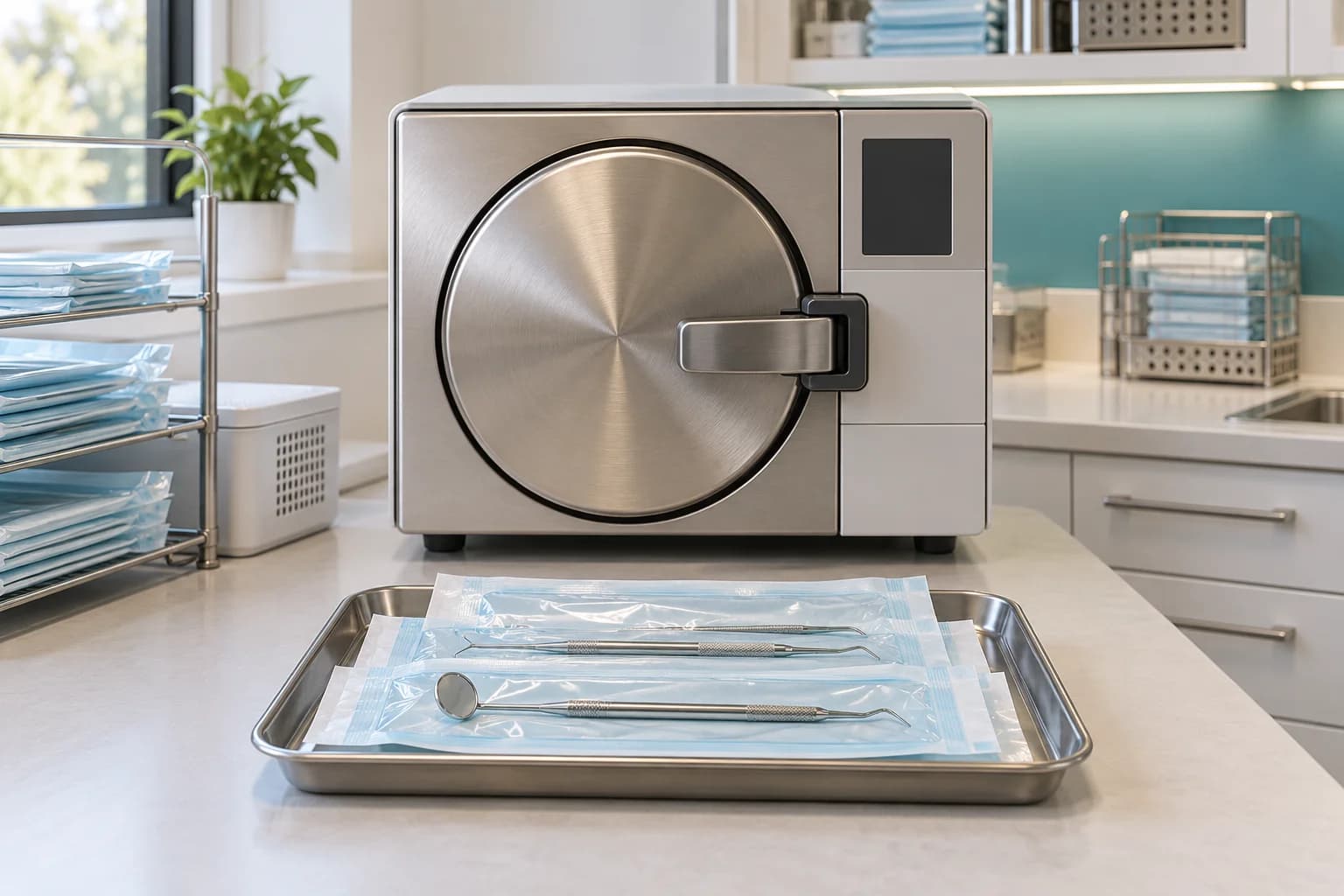
Cleaning removes contamination. Blood, saliva and other organic material can interfere with subsequent decontamination. After cleaning, an instrument must complete the other processing steps required before it can be used again.
Disinfection destroys or inactivates microorganisms under specified conditions. The antimicrobial spectrum identifies the groups against which the product acts; concentration and contact time affect that activity. Not every disinfectant destroys bacterial spores.
Antisepsis treats living tissue. Use a product intended for that particular tissue. A worktop disinfectant is not a skin product, and a skin antiseptic is not automatically suitable for oral mucosa.
Sterilization destroys viable microorganisms, including bacterial spores. A “sporicidal” claim on a chemical product does not establish that an instrument has undergone a suitable, validated sterilization process.
Determine the required outcome before selecting the product. A surgical instrument requires sterilization; immersion in a disinfectant solution is insufficient. A light handle needs a product compatible with its surface, while hands require a hand hygiene product.
How the instrument's use determines processing
Devices fall into three categories according to the tissues they contact:
| Category | Contact during use | Required processing |
|---|---|---|
| Critical | Penetrates soft tissue, bone or other sterile areas | Sterilization using a suitable process |
| Semicritical | Contacts mucosa or damaged skin | Heat-tolerant dental devices are sterilized; for heat-sensitive devices, see the conditions below |
| Noncritical | Contacts intact skin only | Cleaning and disinfection as required by contamination and intended use |
For every category, also follow the instructions for the particular device. For a heat-sensitive semicritical device, CDC recommends first seeking a heat-tolerant or disposable alternative. If neither is available, the guidance specifies high-level disinfection as a minimum. Dental handpieces are an exception: they must be cleaned and heat-sterilized between patients. The selected process must also comply with Bulgarian requirements.
Choose by intended use
Before comparing alcohols, oxidizing agents or ammonium compounds, identify the task:
| Task | What the documentation must specify |
|---|---|
| Hygienic hand disinfection | Use on hands, amount, rubbing technique and time |
| Surgical hand preparation | Explicit surgical antisepsis indication and procedure |
| Clinical contact surfaces | Compatible materials, spectrum, contact time and application |
| Instruments | Suitable devices, dilution, immersion or automated processing, rinsing and subsequent steps |
| Suction system | Compatibility with the particular system and maintenance procedure |
| Waterlines | Use in the specific dental unit, treatment and water-monitoring procedure |
| Impressions and prostheses | Material compatibility and processing without damage |
A separate product is not necessarily needed for every task. One product may have several authorized uses, but each must be supported by its documentation.
Main active-substance groups
The active substance gives you an indication of how a disinfectant works and its possible limitations. To choose a product, you still need the data for its complete formulation: which microorganisms it acts against, at what concentration, for how long and on which materials.
| Group | Useful characteristics | What to check |
|---|---|---|
| Alcohols, including ethanol and isopropanol | Rapid action and evaporation; do not destroy bacterial spores | Flammability, contact time and compatibility with plastics and coatings |
| Chlorine-releasing agents | Potentially broad activity; organic material reduces effectiveness | Corrosion, concentration and compatibility; never mix with acids or ammonia products |
| Hydrogen peroxide | An oxidizer; performance depends on composition and concentration | Claimed activity and permitted materials |
| Peracetic acid | Can be sporicidal under specified conditions | Corrosiveness, solution stability and protective measures |
| Quaternary ammonium compounds | Used in products for certain surfaces | Separate evidence for activity against spores, mycobacteria and viruses |
| Aldehydes, including glutaraldehyde | Applications in high-level disinfection | Inhalation/contact exposure; unsuitable for routine wiping of room surfaces |
| Iodophors and phenolic compounds | Used in antiseptic and disinfectant products with different indications | Exact intended use, residues and compatibility |
For a product containing several active substances, assess the entire formulation. Having two active substances does not, by itself, show that a product is better suited to your task. An “alcohol-free” label is also insufficient: you still need to check the antimicrobial spectrum, contact time, material compatibility and safe handling instructions.
Professional products may contain amines or other active substances. Products from the same chemical group can have different spectra, concentrations and exposure times. Compare current instructions for the exact products.
Read the antimicrobial claims precisely
Identify whether the label claims activity against bacteria, yeasts, fungi, mycobacteria, viruses or bacterial spores. These claims are not equivalent. Activity against enveloped viruses does not mean activity against all viruses; evidence against yeasts does not establish activity against all fungi.
A product may require different contact times for different microorganisms. The shortest advertised time may cover only part of its spectrum. Compare products for the same task, recording spectrum, concentration, time and test conditions together.
For example, two packs of wipes labelled “virucidal” may require different contact times. Check the time for the required activity and whether each wipe is compatible with the surface you will treat.
What EN standards tell you
A standard number identifies a test or assessment framework. It is not a standalone authorization for use in Bulgaria.
| Standard | Meaning when reading product documentation |
|---|---|
| EN 14885 | Framework for applying European standards to chemical disinfectants and antiseptics |
| EN 1500 | Hygienic hand-rub testing, not evidence for instrument processing |
| EN 14476 | Quantitative suspension testing of virucidal activity in the medical area |
| EN 16615 | Testing on nonporous surfaces with mechanical action using wipes or mops |
A suspension test evaluates activity in a liquid environment. A surface test evaluates conditions closer to the corresponding use. For wipes, the disinfectant liquid, wipe material and wiping action all matter. Test results for a liquid concentrate do not establish that it will work equally well with every cloth soaked in it.
Check the edition too. On 19 October 2026, DIN's catalogue lists EN 14476:2025 and EN 16615:2026. An older report is not automatically invalid because of its year; ask whether it supports the claims in the current product documentation. Public catalogues describe scope; full test methods are in the standards themselves.
Use the specified concentration for the full contact time
Effectiveness depends on concentration, contact time, temperature, contamination and whether the product can reach the entire surface being treated. Do not shorten contact time by increasing concentration, or change temperature and dilution to accelerate treatment.
Follow the surface-wetting instructions. If a surface dries too quickly, check the instructions for applying the product and maintaining contact for the full required time. For immersion, solution must reach every part requiring disinfection, including internal channels. Use immersion only where permitted for the device.
Calculating the amount of concentrate
If the instructions specify a 2% product solution by volume with a final volume of 1,000 ml, the calculation is 1,000 × 2 / 100 = 20 ml. Measure 20 ml of product and add water to a total volume of 1,000 ml. Do not add it to an already measured 1,000 ml of water.
The 2% figure illustrates the calculation; it is not a recommended concentration. Use the concentration in the particular product's instructions. This calculation does not automatically apply to mass percentages, active-substance percentages, tablets or special dosing systems. “2% product” differs from “2% active substance”. Seek written clarification before preparing a solution with ambiguous instructions.
Comparing ready-to-use solutions, concentrates and wipes
Ready-to-use solutions are not diluted. Check how long they can be used after opening, how to store them and how to apply them. When comparing concentrates, include the work involved in measuring and diluting them. For wipes, check how much surface each wipe can treat, how long the pack can be used after opening, how it must be closed and when a fresh wipe is needed.
| Criterion | Product A | Product B |
|---|---|---|
| Intended use and legal basis | Enter the details from the documentation | Enter the details from the documentation |
| Activity against target microorganisms | Spectrum, concentration and time | Spectrum, concentration and time |
| Contact time | Same spectrum and conditions | Same spectrum and conditions |
| Equipment compatibility | Instructions or written confirmation | Instructions or written confirmation |
| Dosing and how long the solution can be used | Specific instructions | Specific instructions |
| Safe handling | Measures and protective equipment | Measures and protective equipment |
| Consumption for the same task | Actual quantity and consumables | Actual quantity and consumables |
Leave a cell blank if you lack the supporting information. Ask the supplier to clarify it before adding the product to your practice procedure. For the steps between patients, continue with the practice workflow and Bulgarian requirements.
US EPA or FDA registration does not replace the authorization or conformity evidence required for the Bulgarian market.
Sources
- Dental environmental surfaces CDC · EN
- Chemical disinfectants CDC · EN
- EN 14885: scope and edition DIN Media · DE
- EN 1500: scope and edition DIN Media · EN
- EN 14476: scope and edition DIN Media · DE
- EN 16615: scope and edition DIN Media · DE