Interdental brushes
What interdental brushes do, how to use them each day, and how their shapes and sizes affect your choice.
Created
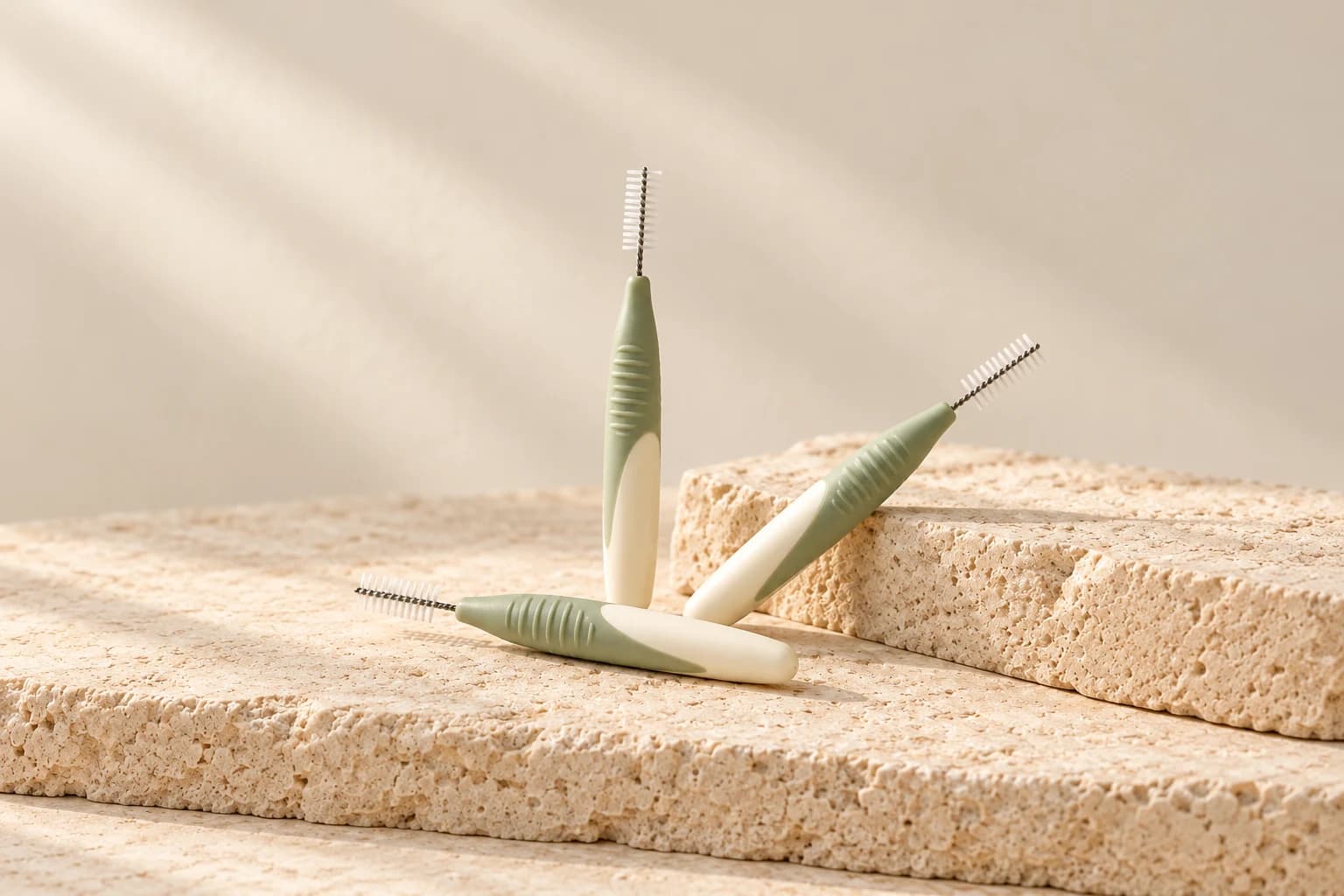
An interdental brush is a small brush for cleaning between your teeth. Its bristles sit around a thin wire attached to a handle, so you can guide it into a gap and clean the sides of the neighbouring teeth near the gumline.
Why clean between your teeth?
A regular toothbrush does not reach all the surfaces between teeth. Plaque, a sticky layer of bacteria, can collect there even when no food is stuck. Removing it each day helps keep the gums healthy.
Interdental brushes are useful where there is enough room for the bristles to pass through. For very tight spaces, floss may be a better option. Cleaning between teeth adds to brushing twice a day with fluoride toothpaste; it does not replace it.
Dental floss and interdental cleaners · How to keep your teeth clean
How the types differ
Besides size, three features affect how you handle and replace the brush:
- Straight or angled handles. An angled head or a longer handle can make back teeth easier to reach. Choose a grip you can control comfortably.
- Cylindrical or tapered heads. A cylindrical head stays roughly the same width along its length; a tapered head narrows towards the tip. Its shape alone does not tell you whether it fits your space.
- Fixed or replaceable heads. Some brushes are replaced as a whole. Others keep the handle and use replacement heads, so check that the sizes you need are available.
Interdental brush sizes, labels and selection · TePe: choosing a comfortable fit (manufacturer)
How to use an interdental brush
Clean between your teeth once a day. Doing it before your evening toothbrushing can help you make it part of your routine.
- In front of a mirror, guide a brush that fits into the gap near the gumline. Insert it from the side, rather than pushing it down between the tops of the teeth.
- Move it gently in and out a few times so the bristles clean the adjacent surfaces.
- Work around your mouth in a consistent order, using a suitable brush for each space.
- Rinse the brush with water after use and let it air dry. Follow the product's instructions for cleaning and reuse.
If it catches or hurts, stop and check the size or angle instead of pushing harder. Ask your dental team to show you the movement if you find it difficult.
TePe: choosing a comfortable fit (manufacturer) · TePe: use, cleaning and replacement (manufacturer)
How to find a comfortable size
Ask your dentist or hygienist to recommend sizes for your spaces. You may need more than one size in the same mouth. A suitable brush makes contact with both tooth surfaces and passes with light resistance, without the wire scraping against the teeth.
You can also try a mixed-size pack. Start with the smallest brush and move up only if the bristles do not reach both sides. If even the smallest will not pass comfortably, ask about floss or another way to clean that space.
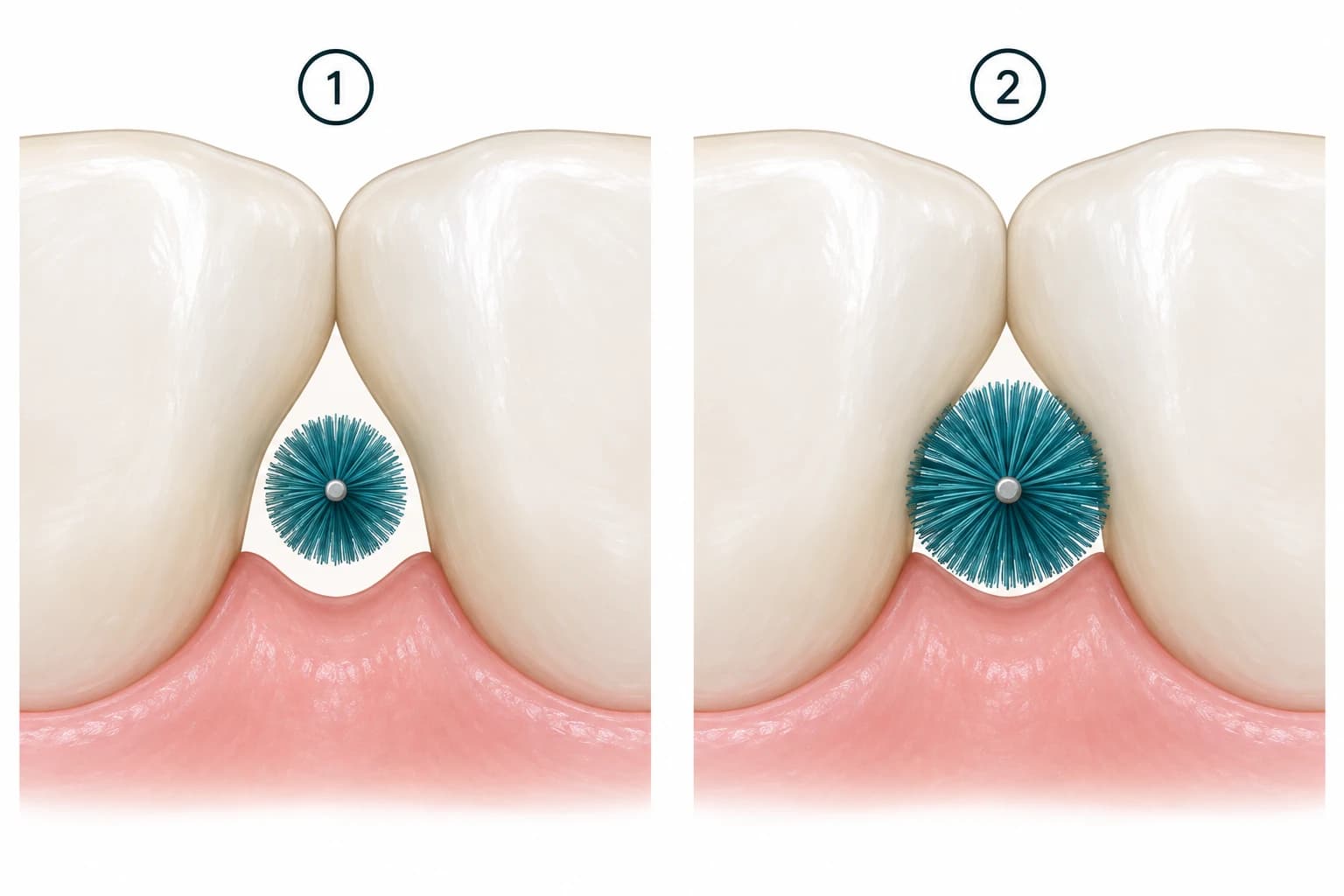
1: the bristles do not reach the teeth. 2: they touch both adjacent surfaces.
How to keep your teeth clean · TePe: choosing a comfortable fit (manufacturer)
How to read the size on the pack
Once you know your sizes, keep the pack or note its details for your next purchase. ISO is a standard size number from 0 to 8; higher numbers mean larger sizes. PHD is the diameter of the smallest test hole the bristled head passes through without bending the wire.
Check what any measurement in millimetres refers to. For example, “0.5 mm” may describe the wire thickness, which is different from PHD. Colours can also identify sizes, but they are not the same across all manufacturers.
| ISO size | Passage diameter (PHD), mm |
|---|---|
| ISO 0 | ≤ 0.6 |
| ISO 1 | 0.7–0.8 |
| ISO 2 | 0.9–1.0 |
| ISO 3 | 1.1–1.2 |
| ISO 4 | 1.3–1.5 |
| ISO 5 | 1.6–1.8 |
| ISO 6 | 1.9–2.3 |
| ISO 7 | 2.4–2.8 |
| ISO 8 | ≥ 2.9 |
For example, if your dentist recommends ISO 2, look for ISO 2 on the pack. It corresponds to a PHD of 0.9–1.0 mm. The table helps you read the label; it cannot determine the right size for your teeth.
ISO 16409: standard sizes and PHD (Table 1) · Interdental brush sizes, labels and selection
Bleeding gums and brush replacement
Inflamed gums may bleed when you first start cleaning between your teeth. Keep the movement gentle. If bleeding continues after the first few days, or you have pain, contact your dentist or hygienist to check your gums, brush size and technique.
Caring for teeth and gums · TePe: choosing a comfortable fit (manufacturer)
Replace it when the bristles are worn or flattened, or the wire is damaged. There is no single replacement interval for every product and pattern of use. Follow the instructions on your pack, including whether it is designed for reuse.
Children and braces
Before introducing an interdental brush to a child, ask their dentist whether it is suitable and how to help them use it. Around braces, the direction of cleaning may differ from cleaning between teeth, so ask for a demonstration.
Dental floss and interdental cleaners · Interdental brush sizes, labels and selection
Sources
- Dental floss and interdental cleaners American Dental Association · EN
- How to keep your teeth clean NHS · EN
- Interdental brush sizes, labels and selection Staehle & Sekundo · EN
- TePe: choosing a comfortable fit (manufacturer) TePe Oral Health Care · EN
- TePe: use, cleaning and replacement (manufacturer) TePe Oral Health Care · EN
- ISO 16409: standard sizes and PHD (Table 1) International Organization for Standardization · EN
- Caring for teeth and gums Oral Health Foundation · EN